
You sit down.
The morning sun hits your desk just right.
Your laptop is open. Your focus is sharp.
You take that first, anticipated sip of your morning ritual.
But something is wrong.
It’s sharp. It’s thin. It’s… sour.
Or maybe it’s the opposite.
Dull. Ashy. A bitterness that clings to the back of your throat like an unwanted guest.
Your morning deserves better.
You deserve better.
Even the most gourmet coffee beans can fall victim to a bad brew if the extraction isn’t quite right.
But don’t pour it down the sink just yet.
Let’s fix it.
Together.
The Secret Language of Extraction
Coffee brewing is a conversation.
Between water and bean.
Extraction is simply the process of water dissolving the flavors from your coffee grounds.
Too little? You get a “zing” that feels like a lemon on your tongue.
Too much? You get a dry, harsh finish that ruins the moment.
Think of it like toast.
Under-extracted is pale, soft bread.
Over-extracted is a burnt, blackened crust.
We’re looking for that perfect, golden-brown center.
The “Sweet Spot.”
Where the flavors are balanced. Round. Velvety.
(Just like our Satin Velvet medium roast.)

If It’s Sour: The Under-Extracted Cup
Is your coffee “bright” in a way that makes you wince?
Does it taste like unripe fruit?
Is the mouthfeel thin and watery?
Your water didn’t stay long enough to pull out the sweetness.
It was a rushed conversation.
The Fix:
- Grind Finer. This is your primary weapon. Smaller particles mean more surface area. More surface area means the water can extract those sugars faster. (One notch finer on your grinder can change everything.)
- Increase Heat. If your water is too cool, it’s “lazy.” Use water closer to 205°F.
- Brew Longer. Let the water linger. Give it thirty more seconds.
You’re asking the water to dig deeper.
To find the soul of those fresh roasted coffee beans.
If It’s Bitter: The Over-Extracted Cup
Does the flavor feel heavy?
Is there a dry, “chalky” feeling on your tongue?
Does it taste like wood or ash?
The water stayed too long.
It started pulling out the things it should have left behind.
The conversation turned into an argument.
The Fix:
- Grind Coarser. Think sea salt instead of table salt. Larger pieces allow the water to flow through more quickly.
- Decrease Heat. Lower your temperature to about 195°F. Give the beans a gentler touch.
- Shorten the Brew. Cut the time. Stop the extraction before the bitterness takes over.
Give the beans space to breathe.

The Golden Variables
Fixing your brew is about adjusting one thing at a time.
Don’t change everything at once.
(That’s chaos, and your morning should be anything but.)
1. The Grind (The Foundation)
If you only change one thing, make it the grind.
It is the most powerful lever you have.
Table salt? Too fine for French Press.
Chunks of rock? Too coarse for your morning pour-over.
Find the middle ground.
Experiment.
Dunk it. Taste it. Adjust it.
We won’t judge. We’ll celebrate the progress.
2. The Temperature (The Energy)
Water is the solvent.
Heat is the energy.
If you use boiling water straight off the stove, you might be “scorching” those delicate flavor profiles.
Wait thirty seconds after the whistle.
Let the water calm down.
Then pour.
3. The Ratio (The Strength)
Sometimes, it’s not the extraction.
It’s the math.
Are you using enough coffee?
A standard “Golden Ratio” is about 1 part coffee to 16 parts water.
If you want it stronger, don’t just brew longer: use more beans.
If you’re in a rush, you can even create a luxury coffee concentrate that holds up through those back-to-back Zoom calls.
The Truth About Your Beans
Sometimes, you can do everything right.
The grind is perfect. The water is filtered. The timing is precise.
And it still tastes… off.
The truth?
You can’t fix stale beans.
Once coffee is roasted, the clock starts ticking.
Oxygen is the enemy of flavor.
That’s why we roast to order.
When you open a bag of Velvet Perk, you’re smelling the peak of the bean’s potential.
If your beans have been sitting in a grocery store aisle for three months, they’ve already lost their song.
They will be bitter because they are tired.
They will be sour because they are lifeless.
Always start with fresh roasted coffee beans.
It’s the foundation of the entire Velvet Descent.
Your New Morning Ritual
Close your eyes.
Take a sip.
What do you taste?
Is it the “Royal Velvet” light-medium roast dancing on your palate?
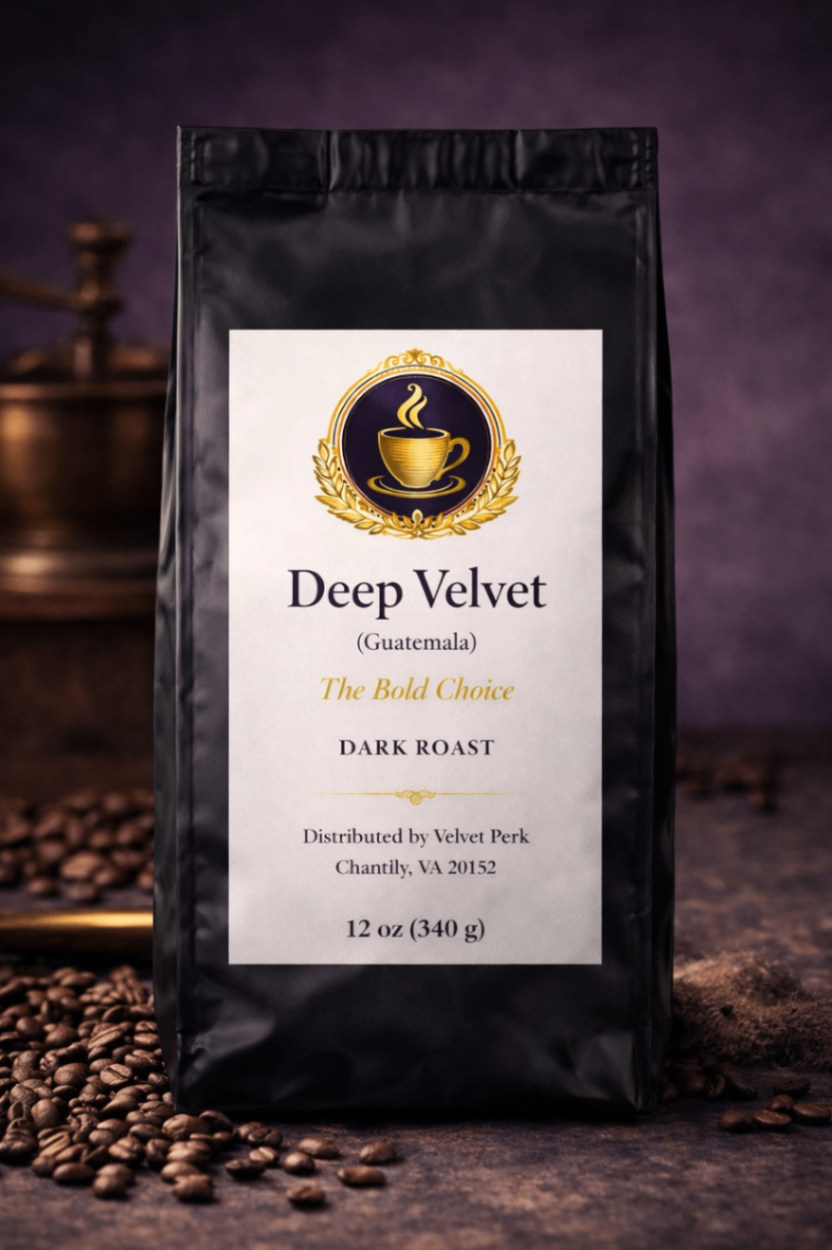
Or the “Deep Velvet” dark roast wrapping you in a warm, chocolatey hug?
Don’t settle for “good enough.”
You work hard. You create. You lead.
Your coffee should be as intentional as your career.
Adjust the grind.
Savor the steam.
Smile at the result.
Go ahead. Have another cup.
We’ll be right here if you need more.
Sip. Savor. Smile.
We’ll see you soon.